
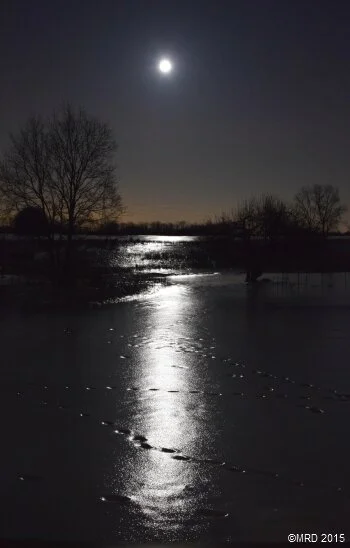
The Ojibwe—who were among the several Native American nations once peopling the lands of the Great Lakes—named the full moon of March the Naabidin giizis, or Snow Crust Moon.
Whether in the Ojibwe’s now endangered language (Anishinaabemowin) or in English translation, the moon’s March name is beautiful—and the farm beneath the Snow Crust Moon is a beautiful sight. In the warming almost-spring air, the surface of the snow melts by day, then freezes by night. And so ice lies smooth and glossy—a cold fabric of translucence—over still-thick snow. A clear full-moon night lights the iced land and the ice-filled tracks of deer to incandescence.
The great human forces of money, machine and power that wrested the Ojibwe’s land from them are now utterly ruining the surface—the crust—of this beautiful world. Still, when I wonder what difference our small native prairie (however cherished), or our few hundred native trees (however carefully tended), can make against those forces, I also remind myself to be grateful for what remains and for what has been: to be thankful for the moon, the ice, and the land, and for those who stewarded the land and dwelled here before me—for the First Nations, whose path crossed the land that is now “my” farm, for the fox and the crane, the rabbit and vole. For the trees. The grasses. And the natural forces of ice, snow, rain and glacier that shaped the land. And yes, for the European-American farmers who cleared forests and fields but also left (and planted) hedgerows to break the winds that carry away fertility, and to provide a place for the wild creatures to dwell, unlike the factory farmers of our times.
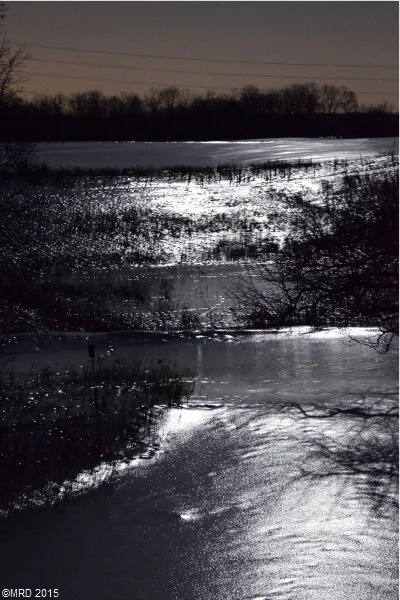
One Ojibwe prayer of thanks says, in part: My Creator...We say thank you to all those animals, wild and domestic, the birds and the fish. Everyone that gave up his or her life here upon the earth, so that we can live...Thank you my creator thank you.
And then there’s W.S. Merwin’s poem, “Thanks”:
...with the animals dying around us
taking our lost feelings we are saying thank you
with the forests falling faster than the minutes
of our lives we are saying thank you...
we are saying thank you faster and faster
with nobody listening we are saying thank you
we are saying thank you and waving
dark though it is
Read Merwin’s entire poem at the Poetry Foundation. The full text of the Ojibwe prayer, and a reading of it in Anishinaabemowin, is available at a website created by the Little River Band of Ottawa Indians.
Thank you.