
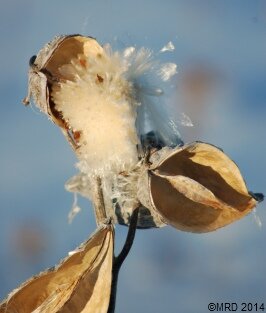
Tramping through the cold fields recently, I came on a stand of young milkweed. Hidden by rye, aster and goldenrod during summer and fall, the milkweed now stands above the taller but more fragile plants' snow-bent and broken stems. I'd have jumped for happiness if I weren't over my knees in snowdrift and weighed down by several layers of long underwear, flannel and wool.
Robert Frost writes of milkweed, "For drab it is its fondest must admit." But I don't admit it at all. (See my July, 2013 post). And if Frost found milkweed so "drab," why did he write "From a Milkweed Pod," print the poem in a small chapbook with a gorgeous and specially commissioned Thomas Nason chiaroscuro engraving of an opened milkweed pod on the cover, and send it to his friends for Christmas in 1954?
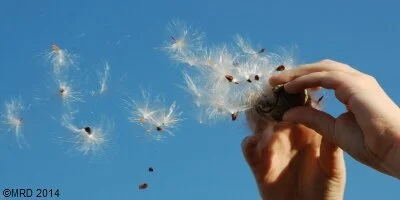
It's not just Frost who's fascinated by milkweed. Philip Levine ("Milkweed"), David Baker ("Monarchs Landing and Flying") and James Wright ("Milkweed") also wrote poems that take milkweed as their central image. The plant is intriguing—its milky, latex-like sap, its status as sole food of monarch butterfly caterpillars. But the fascination is mostly, I think, with the milkweed pod, which indeed has the look and feel of something elegantly and thoughtfully ( if improbably) designed: a miniature Neimeyer, perhaps. In fall and winter, the harp-shaped pods split open, revealing the carefully, efficiently stowed seeds, little voyagers tethered to delicate flossy parachutes; it's lovely to hold a pod up to gusts that take seed after seed, winging them on their way.
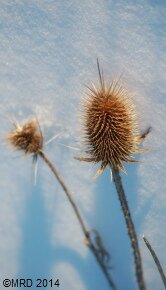

Near the milkweed, in a small depression, I found fifty-some heads of teazel rocketing toward the sky. Teazel (also teasel and teazle) is a handsome plant even in winter—the honeycombed ovoid head cupped by scimitar-shaped sepals—so handsome it's used in dried floral arrangements. Goldfinches love the seeds, and in summer, rings of tiny blossoms (lavender on our farm; other cultivars are white or dark purple) open sequentially from the bottom to the top of the inflorescence.
If teazel is beautiful (in my eyes, at least), it is also beastly. An Old World native brought over the Atlantic—probably for both its decorative features and its use, dried, as a brush to raise the nap on felt and wool—teazel quickly takes over roadsides and field. Along with the non-native rush phragmites, teazel dominates many roadsides and wetlands here in Michigan, and it's a beast to get rid of, with barbs that penetrate leather work gloves and roots that even fire fails to destroy.
The only poem I've found that centers on teazel is by a fairly obscure Victorian-era Irish poet, Owen Blayney Cole, who in "Teasel Tall," rather endearingly exoticizes teazel by comparing it to a pineapple and then declares it useful enough to redeem it from its supposed ugliness:
"Rough from the loom, the Teasel smooths the fleece...
So many virtues if this plant possess,
To beauty be preferr'd its ugliness!"
If you know of any other good poems about either milkweed or teazel, please email me a link and I'll post them: mrd@michelleregaladodeatrick.com .