
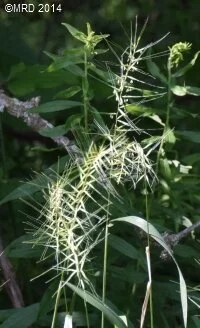
Lagniappe—something extra, something beyond what was labored for, or paid for. The thirteenth pastry in a Baker’s Dozen. An unlooked-for turtle in a vernal pool. A gift. A blessing. This harvest season, I’m continuing last fall’s series of posts about the lagniappes of the land.
That morning in early July, I wasn’t looking for native grasses. Bending a little as I made my way, step by slow step, through the woods, I was intent on finding summer-blooming native wildflowers. In fact, I only noticed the Bottlebrush Grass because the cloud cover broke open, and sun poured through a break in the tree canopy, illuminating the little stand of grass brushing my knees—its charming, starry inflorescences, its delicate leaning stalks.
To notice something is the first step toward learning to be with it—and, I think, toward loving it. In 1786, Goethe—already celebrated as the author of The Sorrows of Young Werther—suddenly left the comforts of Germany and a duke’s patronage to embark on a long yearned-for trip to Italy, where he encountered the unfamiliar work of unfamiliar artists. Some of the paintings puzzled him—others he outright disliked. Nevertheless, he kept going to art galleries, to churches: he kept looking, at paintings by artists whose work he already admired (Raphael, especially), but at those he didn’t like or understand, too.

And because he kept looking, Goethe’s puzzlement and dislike gave way at least once to something else altogether. Two months into his journey, he writes: “I was much impressed by a Circumcision of Guercino’s, because I now know his work fairly well and love it....And so it is with me, as it was with Balaam, the confused prophet who blessed when he had come to curse. If I were to stay longer, this would happen more.”
To stay longer. To look again. To journey to the woods at the edge of your farm or yard or street, along the walking path in the park, or Italy. And once there, to learn to look and to love.
How is it I never noticed Bottlebrush Grass before that morning in July? I’ve learned that it’s one of several native wild rye grasses common in Michigan, and that it thrives in damp, shady spots— like the little woods where I found it. This week, I began harvesting its seeds to sow elsewhere on the farm.