
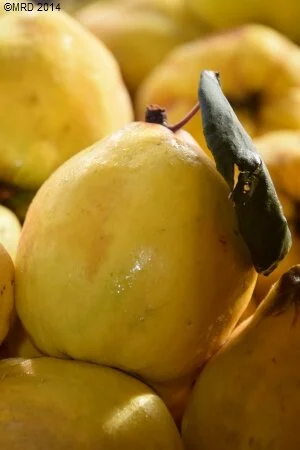
The fragrance of quince is intoxicating. In this first year that our young tree has borne fruit, I understand why the Romans used quince to create perfume. No wonder Plutarch recommended brides eat quince before entering the marriage bed, where “the delight of lips and speech should be harmonious and pleasurable from the beginning.” (Personally, I think the grooms should have given it a go as well).
The fragrance, the flowers, the rounded-out pear shape—perhaps for all these reasons, quince were associated with fertility and the erotic in antiquity. The Greeks believed that where Aphrodite stepped, quince trees sprang up, and some Jewish traditions teach that the fruit of Genesis was actually a quince.
Raw quince is quite astringent unless a special ripening process (unfortunately called “bletting”) is carried out. But cooked, the flesh turns delicate pink, then a gorgeous color somewhere between papaya and magenta. The flavor is unique, reminding me of rose and pear and paradise. In my kitchen, the quince are destined for crisps, jelly, and, if time allows, pâte de coing (dulce de membrillo in Spanish)—a translucent quince preserve that’s delicious and usually eaten with a hard, strong cheese such as Manchego, though it’s also lovely with a soft goat cheese like crottin.